Last updated: September 30, 2026
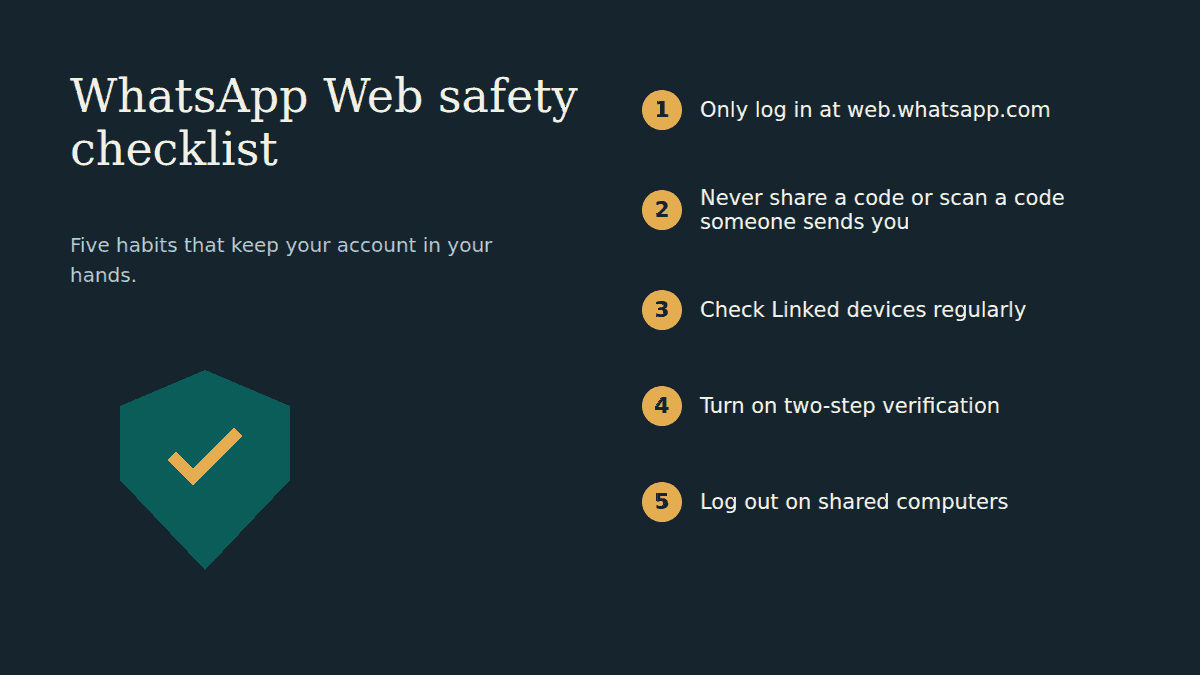
The short answer: WhatsApp Web itself is safe to use. The risk comes from someone else getting a computer linked to your account, usually by tricking you into scanning a code, typing a code, or logging in on a fake website. Only log in at web.whatsapp.com, never share or enter a code someone sends you, check Linked devices on your phone regularly, turn on two-step verification, and log out of computers that aren’t yours.
This guide explains why each of those habits matters, so you can spot a trick you haven’t seen before, not just the ones listed here.
How WhatsApp Web accounts actually get taken over
Your messages are end-to-end encrypted, and WhatsApp says each linked device connects to your account independently with the same level of encryption. So attackers rarely try to “break in”. It’s much easier to get you to let them in. Nearly every takeover follows one of these patterns:
- A linking trick. You’re persuaded to scan a code or type a code into WhatsApp that actually links the attacker’s computer to your account.
- A stolen verification code. Someone tries to register your phone number on their phone and asks you to “forward the code you just got by mistake”.
- An open computer. You used WhatsApp Web on an office, library or cyber café computer and never logged out.
- An unofficial app or website. A “WhatsApp tool”, mod app or extension that asks you to link your account.
The five habits below close each of these doors.
1. Only log in at web.whatsapp.com
The official address is https://web.whatsapp.com. Before you scan anything, look at the address bar and check that the part just before the first single “/” is exactly web.whatsapp.com. Fake pages use addresses that look close, add extra words, or hide the real address behind a shortened link.
The safest routine: type the address yourself once, then bookmark it and always use that bookmark. Don’t “log in to WhatsApp” from a link in a message, an email, a search ad or a social media post. Also remember: WhatsApp Web never asks for a username or password. A page that does is fake.
2. Never share a code, and never scan or enter a code someone sends you
This is the single most important rule. There are two kinds of codes, and both can be used against you:
- The verification code WhatsApp sends by SMS or call when a phone number is registered. WhatsApp’s own advice is to never share it with anyone. If you get one you didn’t ask for, someone typed your number, either by mistake or to try to take your account. Without that code, they can’t finish.
- Linking codes: the QR code on a computer screen and the 8-character code used to link with a phone number. Legitimately, these only ever go from a computer you are sitting at into your own phone. If a website or person shows you a code to scan or type into WhatsApp, you’d be linking their device to your account.
Scammers dress these requests up well. Security researchers at Gen Digital described a campaign they called “GhostPairing” in December 2025: victims got a message from a friend’s (already hijacked) account saying something like “I just found your photo!”, with a link to a fake page that asked them to “verify” by scanning or entering a code. That code linked the attacker’s device. Reports in 2026 described the same trick disguised as “vote for my friend in a competition”. The disguise changes; the ask is always a code.
Quick safety tip: when linking, WhatsApp may show you the name and location of the device asking to link, or warn you about an unrecognised device with a Don’t link button. If you didn’t just start a login on a computer in front of you, tap Don’t link.
3. Check Linked devices regularly
Every computer, tablet or other device connected to your account appears under Linked devices on your phone. It takes ten seconds to look, and it’s the fastest way to catch a problem. If you see anything you don’t recognise, tap it and choose Log out. We walk through it step by step in how to check if someone is using your WhatsApp Web.
WhatsApp also recommends keeping push notifications turned on for WhatsApp on your phone. When a new device is linked, you can tap the notification to review it and remove it if you don’t recognise it.
4. Turn on two-step verification (and consider a passkey)
Two-step verification adds a password that’s needed when your number is registered on a phone. Even if someone gets your SMS code, they’d still need that password. WhatsApp is moving from the old 6-digit PIN to a password, and you can add an email address so you can reset it if you forget.
- On your phone, open WhatsApp Settings > Account > Two-step verification.
- Turn on two-step verification.
- Create a strong password and confirm it. Don’t reuse a password from another account.
- Add an email address you can access (recommended), then follow the prompts.
You can also set up a passkey, which links your account to your phone’s own security (fingerprint, face or screen lock) and makes logging in faster when two-step verification is on. WhatsApp’s Help Center article on two-step verification links to the current setup steps.
5. Log out of computers that aren’t yours
On a shared, office, school or cyber café computer, anyone who sits down after you can read and send messages as you until the session is closed. Before you leave:
- Open WhatsApp’s Settings on the computer and choose Log out.
- Forgot? Log it out from your phone: Linked devices, tap the computer, Log out. This works from anywhere.
- If the browser offers a private or incognito window, use it on shared computers, and don’t let the browser “remember” anything.
Avoid unofficial apps, mods and “WhatsApp tools”
WhatsApp says you should only link your account on its official apps and websites: WhatsApp Web, WhatsApp for Windows and Mac, and its official apps for tablets and other supported devices. Unofficial apps and websites (modified WhatsApp versions, “chat backup” sites, “see who viewed your profile” tools) can’t be checked for security, and WhatsApp warns that linking your account to one, now or in the past, can lead to a temporary or permanent ban. They can also be used to send spam and scams to your contacts from your account.
Warning signs something is wrong
- A device you don’t recognise in Linked devices
- A WhatsApp verification code or linking notification you didn’t request
- Friends asking about messages you didn’t send, especially requests for money, votes or codes
- Chats marked as read that you haven’t opened
If you notice any of these: log out every device you don’t recognise, turn on two-step verification if it’s off, and warn your contacts not to act on recent messages “from you”. If you’ve been logged out of WhatsApp on your own phone, use WhatsApp’s official guidance on recovering a compromised account in the WhatsApp Help Center.
Frequently asked questions
Is WhatsApp Web safe to use?
Yes, when you use the official site at web.whatsapp.com. Messages are end-to-end encrypted on linked devices just as they are on your phone. The real risks are fake websites, shared codes and computers you forget to log out of.
Can someone use my WhatsApp Web without my phone?
They can’t link a new computer without your phone being involved. That’s why scammers try to get you to scan or enter a code for them. Once a device is linked, though, it keeps working even when your phone is off, which is why checking Linked devices matters.
Does logging out on my phone log out WhatsApp Web too?
To disconnect a specific computer, use Linked devices on your phone and choose Log out for that device. That removes it right away without affecting your phone.
Related guides
- How to check if someone is using your WhatsApp Web
- How to log in to WhatsApp Web safely
- New to WhatsApp Web? Start here
Sources checked: WhatsApp Help Center articles “About linked devices”, “Received verification code without requesting it”, “About two-step verification” and “How to manage two-step verification settings” (faq.whatsapp.com); Security Affairs report on the GhostPairing campaign (December 2025); Forbes report on the voting-link scam (August 2026). Reviewed September 30, 2026.
This is an independent guide. We are not affiliated with, endorsed by, or connected to WhatsApp or Meta.
Guides: Login & Access · Features & Calling · Desktop & Other Ways · Safety · Fix Problems · Start Here
About this site: About · Contact · Privacy Policy · Terms of Use · Cookies · Disclaimer